


Maulidur Rasul 2026 Clinic Holiday Notice – 25 August 2026 | Dr Low Child Specialist Clinic Batu Pahat
Dr Low Child Specialist Clinic Batu Pahat – Child Doctor BP
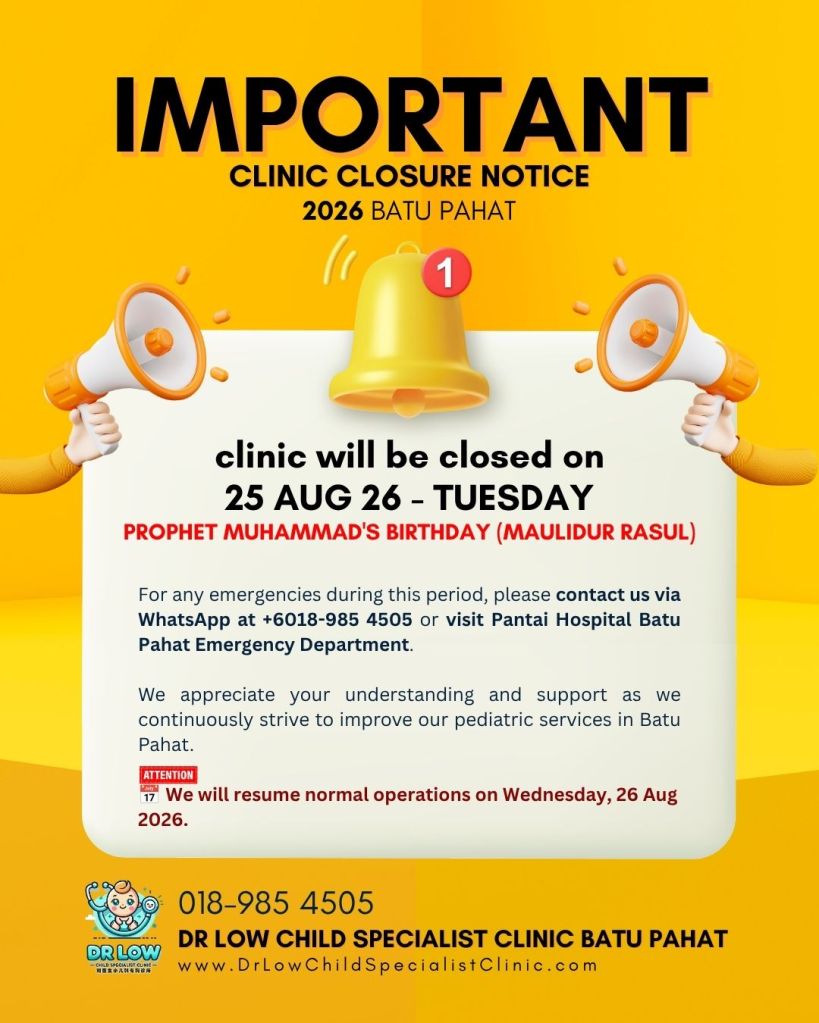
Dr Low Child Specialist Clinic Batu Pahat will be closed on Tuesday, 25 August 2026 in conjunction with Maulidur Rasul 2026 (Prophet Muhammad’s Birthday). The clinic will resume normal operations on Wednesday, 26 August 2026. Parents are encouraged to plan their child’s appointments and medications in advance and know where to seek medical attention if their child becomes unwell during the public holiday.
Maulidur Rasul 2026 Clinic Holiday Notice
Dr Low Child Specialist Clinic Batu Pahat would like to inform all parents and families that our clinic will be closed on Tuesday, 25 August 2026, in conjunction with the Maulidur Rasul public holiday, also known as the observance of Prophet Muhammad’s Birthday.
The clinic will resume normal operations on Wednesday, 26 August 2026.
Parents who are planning a paediatric consultation, follow-up appointment, vaccination, newborn assessment or other child health services around this period are encouraged to take note of the temporary closure and plan accordingly.
Clinic Holiday Schedule
Tuesday, 25 August 2026
🔴 Clinic Closed – Maulidur Rasul Public Holiday
Wednesday, 26 August 2026
🟢 Clinic Operating as Usual
For urgent enquiries during this period, please contact us via WhatsApp at +6018-985 4505.
For medical emergencies, please visit the Pantai Hospital Batu Pahat Emergency Department.
What Is Maulidur Rasul?
Maulidur Rasul is an important Islamic observance commemorating the birth of Prophet Muhammad.
In Malaysia, Maulidur Rasul is observed as a public holiday, with various religious, educational and community activities held to commemorate the occasion.
For families in Batu Pahat and throughout Johor, the public holiday may also affect the operating hours of clinics, healthcare facilities, schools, government offices and other services.
For this reason, parents of young children may find it useful to prepare ahead, particularly when a child is currently taking medication, recovering from an illness or requires regular medical follow-up.
Preparing Your Child’s Healthcare Before a Public Holiday
Public holidays are a good reminder for parents to check whether they have everything necessary to manage their child’s routine healthcare needs at home.
This is particularly helpful for families with babies and young children because their condition can sometimes change relatively quickly.
Before the holiday begins, consider checking your child’s regular medications and other healthcare supplies.
For example, if your child is taking medication prescribed by a doctor, make sure there is enough medication to continue according to the prescribed instructions.
Parents may also want to ensure that commonly used items such as a thermometer are available and functioning properly.
If your child has a known medical condition and has previously been given an action plan or specific instructions by the treating doctor, keep these instructions readily accessible.
Most importantly, know where you can obtain medical assistance if your child’s condition becomes more serious while the usual clinic is closed.
What If My Child Becomes Unwell During the Public Holiday?
Not every childhood illness requires emergency treatment.
Children can develop common symptoms such as fever, cough, runny nose, vomiting, diarrhea, reduced appetite or mild discomfort. The appropriate response depends on several factors, including the child’s age, severity of symptoms, hydration, breathing, activity level and general condition.
Parents should observe the whole child, rather than focusing only on a single number or symptom.
For example, when a child has a fever, the temperature itself is useful information, but it is equally important to observe whether the child remains responsive, is drinking adequately, is passing urine, is breathing comfortably and is behaving reasonably normally for their condition.
A child who appears increasingly unwell requires more attention even if an individual symptom initially appears mild.
When Should Parents Seek Urgent Medical Attention?
Parents should seek urgent medical assessment if they are concerned that their child’s condition is serious or deteriorating.
Important warning signs may include:
- Difficulty breathing, very fast breathing, struggling to breathe or unusual breathing patterns
- Bluish or unusually pale lips or skin
- A child who is extremely weak, unusually sleepy, difficult to wake or poorly responsive
- Seizure or abnormal body movements
- Persistent vomiting with difficulty keeping fluids down
- Signs of significant dehydration, such as markedly reduced urination, very dry mouth or unusual lethargy
- Severe or worsening pain
- A rapidly worsening allergic reaction, particularly when associated with facial swelling or breathing difficulty
- Significant injury, uncontrolled bleeding or suspected serious trauma
- A baby or child whose overall condition is rapidly worsening
- Any situation in which a parent feels the child may require immediate medical attention
Young infants deserve particular attention because symptoms can sometimes be less obvious.
A fever of 38°C or higher in a baby younger than 3 months generally warrants prompt medical assessment, even when the baby initially appears relatively well.
When you are unsure whether your child’s symptoms can safely wait until the clinic reopens, it is safer to seek appropriate medical assessment rather than delay care when the child appears significantly unwell.
Fever During a Public Holiday: What Should Parents Observe?
Fever is one of the most common reasons parents seek medical advice for children.
A fever is usually a sign that the body is responding to an illness or infection. The cause may be a common viral infection, but other conditions can also cause fever.
While monitoring a child with fever, parents can pay attention to several practical observations:
Is your child drinking?
Children who are unwell may drink less than usual, but persistent refusal of fluids can increase the risk of dehydration.
Is your child passing urine?
A significant reduction in urination may indicate inadequate fluid intake or dehydration.
How is your child’s breathing?
Breathing should not appear unusually difficult, laboured or excessively fast.
How responsive is your child?
A tired child with fever may sleep more, but they should generally still be responsive when awake. Being very difficult to wake or unusually unresponsive is concerning.
Are the symptoms getting better or worse?
The pattern over time can be just as important as the symptoms at one particular moment.
Parents should seek medical attention when they are concerned about the child’s general condition or when warning signs develop.
Vomiting and Diarrhoea: Watch for Dehydration
Vomiting and diarrhea are also common childhood illnesses that can occur unexpectedly during weekends or public holidays.
One of the main concerns is dehydration, especially in babies and younger children.
Parents should monitor whether their child can take fluids, whether vomiting is persistent and whether urine output has decreased significantly.
Possible signs of dehydration can include:
- Reduced urination
- Dry mouth or lips
- Reduced tears when crying
- Unusual tiredness or lethargy
- Poor fluid intake
- Increasing weakness
A child who cannot keep fluids down, appears significantly dehydrated, becomes unusually sleepy or has other concerning symptoms should be medically assessed.
Cough and Breathing Problems: Look Beyond the Cough
Coughs are very common among children and are frequently associated with respiratory infections.
However, parents should pay particular attention to how the child is breathing, not simply how frequently the child coughs.
Seek medical attention if the child appears to be struggling to breathe, breathing unusually quickly, using extra effort to breathe, becoming bluish around the lips, or becoming increasingly weak or lethargic.
Babies and young children may not be able to describe breathing difficulty themselves, making parental observation especially important.
Do Not Delay Emergency Care Because the Clinic Is Closed
A clinic holiday notice should never be interpreted as a reason to postpone emergency medical care.
If your child develops symptoms suggesting a medical emergency, you do not need to wait until Dr Low Child Specialist Clinic Batu Pahat reopens on Wednesday, 26 August 2026.
Please proceed to an appropriate Emergency Department for assessment.
During this public holiday period, families in Batu Pahat who require emergency medical attention may visit the Pantai Hospital Batu Pahat Emergency Department.
Planning Follow-Up Appointments Around Maulidur Rasul 2026
If your child is due for a routine follow-up, parents can arrange the appointment around the public holiday closure.
This may include follow-up for:
- General paediatric conditions
- Newborn assessment
- Growth monitoring
- Developmental assessment
- Vaccinations
- Feeding concerns
- Asthma and allergy
- Eczema and skin conditions
- Jaundice assessment
- Blood testing
- Recovery after a recent illness
Routine appointments can generally be arranged when the clinic resumes normal operations on Wednesday, 26 August 2026.
If your child’s condition worsens while waiting for a scheduled follow-up, however, do not wait solely for the appointment date. Seek earlier medical assessment when necessary.
What About My Child’s Vaccination Appointment?
Parents whose child’s vaccination schedule falls close to the public holiday can contact the clinic regarding appointment arrangements.
A short scheduling difference is not automatically a reason for panic. The appropriate timing depends on the particular vaccine, the child’s age, previous doses and vaccination history.
If you are unsure about the next vaccination date, bring or refer to your child’s vaccination record when discussing the appointment with the clinic.
Avoid restarting, skipping or changing a vaccination schedule on your own because of a public holiday. The schedule can be reviewed appropriately when the clinic reopens.
What If My Child Is Taking Medication?
If your child is currently taking medication prescribed by a doctor, continue using it according to the instructions provided unless you have been advised otherwise by a healthcare professional.
Before a public holiday, it is useful to check whether there is enough medication remaining.
Parents should avoid changing the dose, stopping prescribed medication early or using another person’s medication without appropriate medical advice.
If your child develops an unexpected reaction to medication or becomes significantly unwell, seek medical assessment.
A Simple Public Holiday Health Checklist for Parents
Before the Maulidur Rasul public holiday, parents may want to check:
✓ Is there enough of my child’s regularly prescribed medication?
✓ Do I have a working thermometer at home?
✓ Do I know my child’s medication instructions?
✓ Do I have my child’s relevant medical and vaccination information available?
✓ Do I know where to seek help if my child’s condition suddenly worsens?
✓ Do I recognise the warning signs that should not wait until the clinic reopens?
A little preparation can make it easier to respond calmly and appropriately if a child becomes unwell unexpectedly.
A Reminder to Parents in Batu Pahat
Public holidays are opportunities for families to spend time together, but childhood illnesses do not always follow clinic operating hours.
Knowing what symptoms can be monitored and recognizing warning signs that require medical attention can help parents make more informed decisions.
Dr Low Child Specialist Clinic Batu Pahat will be closed on Tuesday, 25 August 2026 for Maulidur Rasul and will resume normal operations on Wednesday, 26 August 2026.
For urgent enquiries during the closure:
WhatsApp: +6018-985 4505
For medical emergencies:
Please visit Pantai Hospital Batu Pahat Emergency Department.
Wishing all families observing Maulidur Rasul a meaningful and peaceful public holiday.
Parents, what is one child-health item you always make sure you have at home before a long weekend or public holiday — a thermometer, medication, oral rehydration solution, your child’s health records, or something else?
Share your experience in the comments. Your answer may remind another parent of something useful to prepare.
You may also save or share this clinic holiday notice with other parents and families in Batu Pahat so they are aware of the clinic closure on 25 August 2026.
#DrLowChildSpecialistClinic #DrLowChildSpecialistClinicBatuPahat #ChildSpecialistBatuPahat #PaediatricianBatuPahat #PediatricianBatuPahat #KlinikPakarKanakKanak #BatuPahat #BatuPahatJohor #Johor #MaulidurRasul #MaulidurRasul2026 #PublicHolidayMalaysia #ClinicHolidayNotice #ChildHealth #ChildHealthMalaysia #BabyHealth #PaediatricCare #PediatricCare #ParentingMalaysia #ParentsBatuPahat


